

TREATMENTS
HEART TREATMENT: YOUR HEART IN SAFE HANDS
Dr Omar Ali is a specialist in coronary and valve disease. He offers world-class patient-tailored treatment having years of experience and training in internationally recognized centers. He is the clinical lead for heart attack treatment (primary angioplasty service and acute coronary syndromes) and cardiac rehabilitation service. He is also the clinical lead for patient safety in the catheter laboratory. Dr Omar Ali also works closely with colleagues to provide a full range of heart treatments from coronary angioplasty to complex devices and arrhythmia management and cardiac surgery. He is committed to providing excellent care by making sure all complex cases are reviewed in a Heart MDT meeting in line with international guidelines.
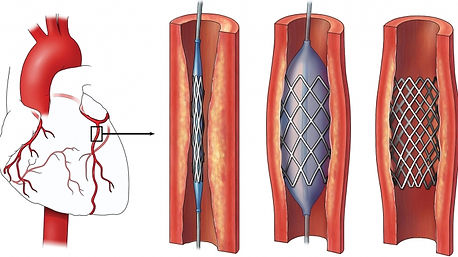
Coronary Angioplasty
This treatment helps improve the blood supply to your heart muscle by widening narrowed the coronary arteries and inserting a small metal tube called a stent. Angioplasty can help to relieve angina symptoms and is also used as an emergency treatment for people who've had a heart attack.You’ll have an angiogram before your angioplasty to look inside your arteries and check where the blockages are and how much they are blocked. An angiogram often happens as part of the same procedure.
A catheter (a fine, hollow tube) with a small inflatable balloon is passed to the heart from your wrist (or occasionally the top of the leg). Dr Omar Ali prefers to perform all of his procedures from the wrist (also called radial access) as there are a number benefits to you-please read below. An X-ray is used then to direct the catheter to a coronary artery to reach the narrowed segment. The balloon is then gently expanded so that it squashes the fatty tissue inside the artery. The balloon is removed and another balloon which is covered with a mesh tube is inserted into the blocked artery. This balloon is then expanded to press the stent against the vessel wall to keep the artery open. The balloon is then removed.
Coronary angioplasty is now a routine procedure and is almost invariable carried out with stents placed inside the coronary artery unless the artery is not large enough to accept one. We can also carry out coronary angioplasty if you have had coronary artery by-pass graft surgery but your graft has become narrowed. Coronary angioplasty normally takes between 30 minutes and two hours.
Preparation for Angioplasty
-
Prior to having an angioplasty, you will be given 'anti-platelet drugs'. This includes Aspirin and Clopidogrel daily starting few days before your procedure date. You will be asked to continue taking both drugs for at least 12 months.
-
At the start of the procedure Dr Omar Ali will give you a local anaesthetic to numb a small area over the right wrist. Then a catheter – a fine, flexible, hollow tube – with a small inflatable balloon at its tip is passed through the wrist artery (radial artery).
-
Dr Omar Ali will inject some dye (contrast) into the catheter and the arteries can be seen on an x-ray screen. It's normal to feel a hot flushing sensation when the dye is injected.
-
The balloon is then gently inflated so that it squashes the fatty plaques - or deposits - against the artery wall, widening the artery and allowing the blood to flow more easily.
-
A stent - a small tube of stainless steel mesh - is already in place on the balloon. As the balloon is inflated, the stent expands so that it holds open the narrowed artery. The balloon is let down and removed, leaving the stent in place.
-
Sometimes when the balloon is inflated in the coronary artery to place the stent mild chest pain (angina) can be experienced. This can be normal and you may let Dr Omar Ali know at the time of the procedure. The pain normally passes away once the stent is placed and the balloon is removed.
-
Dr Omar Ali will then remove the catheter at the end of the procedure and a special compression wrist band is applied to the puncture site to stop any bleeding.
-
You will then be able to walk to your chair or bed accompanied by a nurse
-
We will continue to monitor you for the next two hours or until you feel back to normal.
-
You will be given a copy of the report and your GP will be informed of the result as well.
After care:
-
The special wrist band will be removed over the next 2 hours
-
You’ll usually be able to go home the same day when you feel ready or the next day, but make sure someone can take you home
-
Special instruction and a contact number will be given to you in case you have any problems
-
Dr Omar Ali will arrange a follow up appointment after the procedure to check on your progress and response to the treatment
-
It’s best to avoid doing any demanding activities, such as heavy lifting, for a week or so.
-
You shouldn’t drive for at least a week after having angioplasty .
-
If you’ve had a planned angioplasty with no complications you may be able to return to work within a few days, depending on the type of work you do.
-
If you’ve had an emergency angioplasty or a heart attack you may need to take a few weeks off.
-
Dr Omar Ali will arrange cardiac rehabilitation programme for you.
Why am I having the procedure through the wrist (radial artery access)?
-
Many modern centers are now offering coronary angioplasty through the wrist. Dr Omar Ali has many years’ experience using the radial artery. International research suggests that this should be the preferred access in most patients.
-
Because the radial artery in the wrist is smaller than the femoral artery in the groin, it is much easier to apply direct pressure to the puncture site to stop the bleeding.
-
No collagen plug is left behind in the radial artery unlike the use of the femoral artery in the groin where large collagen plug is routinely used to stop any bleeding
-
Also, radial artery access allows many patients to get out of bed and walk around right after their procedure.
-
Some discomfort may be experienced with radial artery access however, the femoral artery in the groin is also associated with some discomfort. Both can be minimised with the use of local anaesthetics and analgesia.
-
Patients tend to prefer to have the wrist exposed during the procedure rather than the groin.
How successful is coronary angioplasty?
Coronary angioplasty is a highly effective and successful procedure. Complications are rare. There is a tiny chance that a small tear could occur in the artery or the artery could block in the process of it being stretched in which a stent or rarely by-pass surgery may be required. The chance of that happening is probably less than 1 in 3-400.


Maintaining a Healthy Heart lifestyle changes
Maintaining a healthy heart is easy!. Watch the video below to see how a healthy heart works?. Your heart is a muscle about the size of a fist. It is in the middle of your chest tilted slightly to the left. Each day, your heart beats about 100,000 times. It pumps about 23,000 litres (5,000 gallons) of blood around your body.
Simple lifestyle changes make a huge difference and keeps your heart healthy. Look through the suggestions made below and see what you can do to improve your heart health:

Eating well
Eating well and maintaining a healthy weight

Managing
Mangaing blood pressure, cholesterol and diabetes

Keeping active
Staying active boosts energy health overall

Smoke-Free Life
Quitting smoking and reducing stress
Disclaimer: Information provided on this page has been linked to the British Heart Foundation Website. The inclusion of any links does not necessarily imply a recommendation.